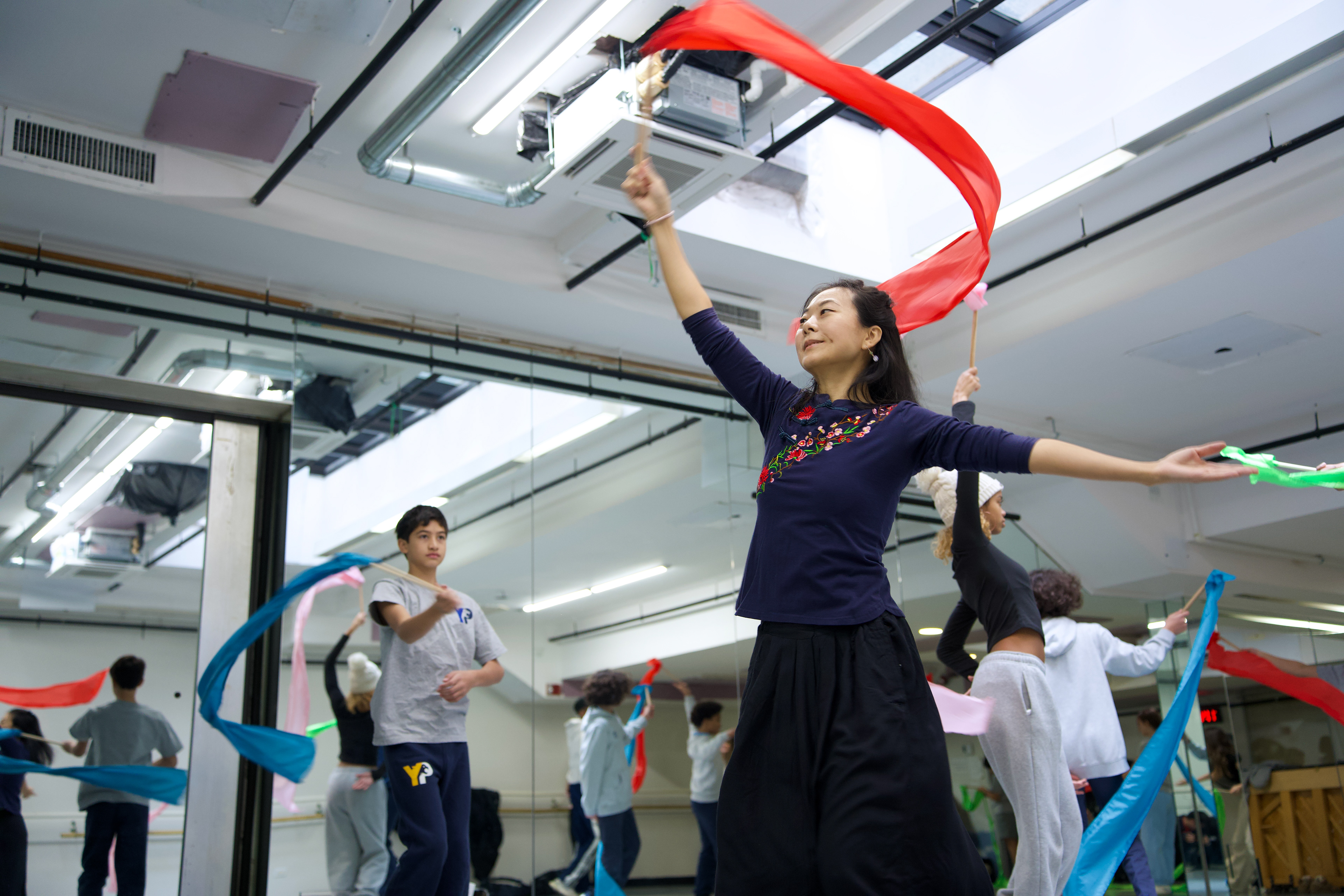
Ling Tang leads students through a ribbon dance sequence as part of her Chinese performing arts residency at York Prep School in New York on Monday, Dec. 8, 2025. ©Chengchao Li 2025
NEW YORK – Rain had tapped against the windows all morning, turning Queens into a gray blur. But inside the school auditorium, the light was warm. Ling Tang stood center stage in a purple silk tunic embroidered with roses. Her hair was pulled back, a pink pom-pom bouncing slightly when she turned her head.
She held up a folded fan – bright and colorful – and looked out at two dozen third-graders sitting on the floor. Most of them had never seen Chinese dance up close. Some had never heard Mandarin spoken outside of a restaurant. Ling waited a moment to see if they were ready.
“Before we move,” she said, “tell me something: what do you know about China?”
Hands raised. One student shouted with a laugh: “Sushi!”
A few kids giggled. Ling smiled. She didn’t scold the child for being wrong. Instead, she used the moment to explain what she was really doing there. She wasn't just teaching dance steps. She was translating a culture – its gestures, history and rhythm – for a classroom that didn't speak the language.
For more than a decade, Ling, 41, a Wuhan-trained dancer and New York-based teaching artist, has worked in public schools across Maryland and New York. She introduces Chinese dance to American children through workshops that end in big performances. Her job is physical – teaching them how to move fans, ribbons, and wrists – but it is also about ideas. She teaches culture as something you can feel in your body. And she is doing it at a moment when the routes that once carried artists between China and the United States have narrowed because of political tension and censorship and shrinking cultural exchange. The classroom has become one of the few places where people from both countries can still connect.
On stage, Ling played music from an old Ipod she carried for the past 10 years. A nursery song called “Molihua” (Jasmine Flower) filled the room. She opened her hands slowly, fingers blooming like flowers, and the children followed. Some were serious, others were unsure. When the music changed to a kung fu rhythm, Ling dropped into a low squat, her weight settling into her legs. She wasn’t asking them to become professional dancers. She was asking them to feel how a different culture moves.
Every few minutes, she rotated the students so each child got a chance to stand in the front row. She corrected them gently: a wrist softened, a shoulder lowered, a fan lifted higher. Her teaching was a series of small translations – turning strange movements into something the kids could understand, and then turning that understanding into confidence.
In China, she said, dance education often focused on the group. In this American classroom, she looked for the child who wanted to hide. This focus on the individual didn’t come from a textbook. It came from her own experience of feeling different.
Long before she stood on stage with American children, Ling was one of young students in Wuhan, China. She split her time between a strict school and a dance studio an hour from her home. At her competitive high school, classmates measured their futures by test scores. Dance was seen as a backup plan.
“In China at that time,” she said, “people believed if you chose art, it was because your grades were bad.”
Even if her family didn’t say it, the system around her did: Good grades mattered most, and art was just a hobby. She learned discipline early – how to repeat a movement until it was perfect. But she also learned what it felt like to pursue art in a place that questioned its legitimacy.
After high school, she followed her father to the United States. She started at a community college in Maryland, taking English classes before she could handle university work. The adjustment wasn’t just about language. It was a whole new way of thinking. In China, dance was just physical training. In the U.S., dance was something you could read and write about, too.
In college, she took classes on intercultural communication and performance theory. She had to write essays and make arguments, not just rehearse. In one speech class, she gave a presentation on Chinese dance. For the first time, she realized she could explain dance as knowledge, not just show it. She began to understand that teaching was more than just repetition.
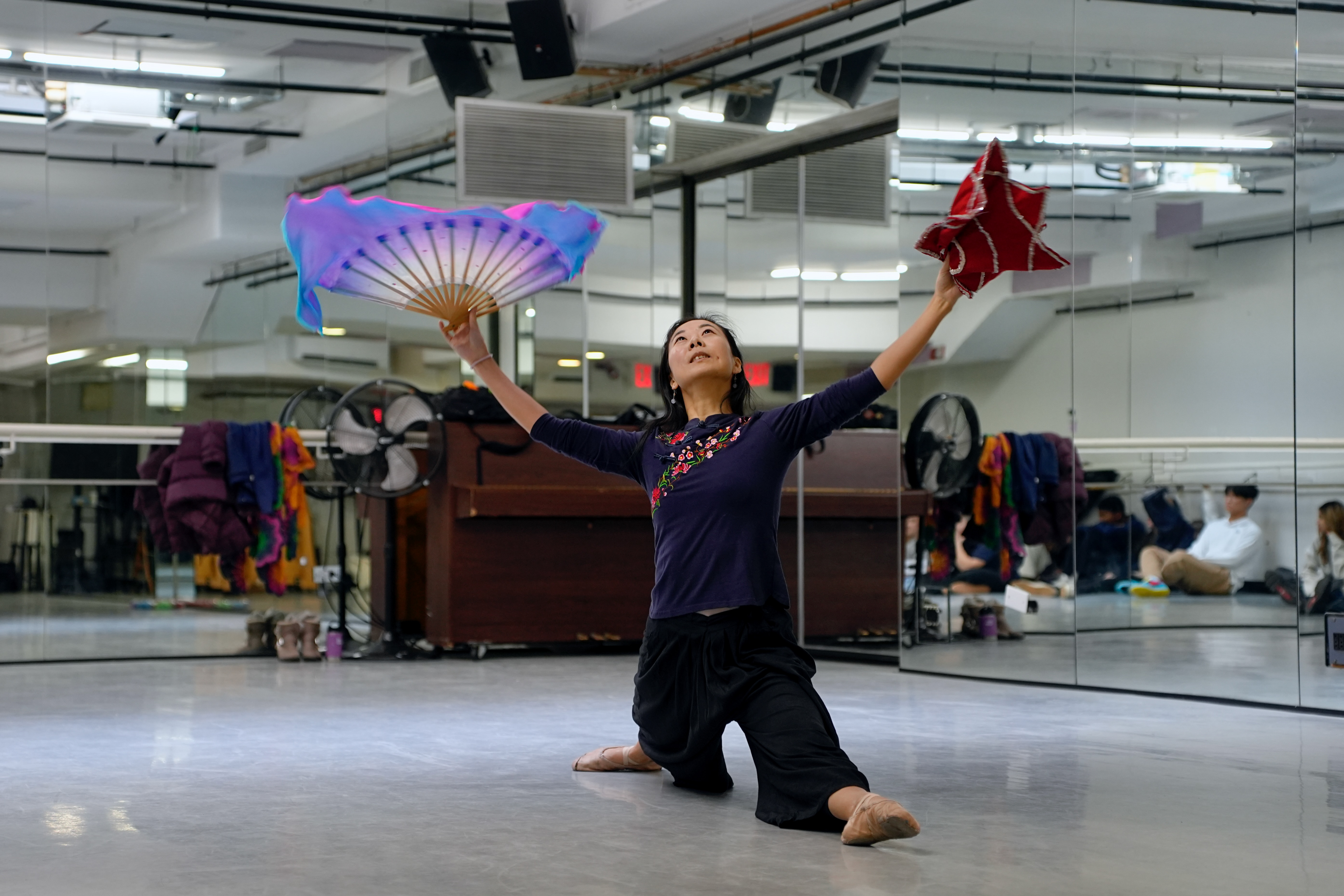
Ling Tang performs a traditional Chinese fan dance demonstration for middle school students during her cultural workshop at York Prep School in New York on Monday, Dec. 8, 2025. ©Chengchao Li 2025
“It’s not just teaching movement,” she said. It is the difference between drilling a dance sequence and helping students understand what that sequence means.
Dance became a language she could translate in both directions: from China to the U.S., and from the stage to the classroom.
Chinese dance, as Ling first learned it, followed a strict visual logic: symmetry, stillness, precision. The audience was meant to see a collective image, not an individual. Even the dancer’s face was part of that uniform picture.
She described how expressions were often standardized. In some training systems, every dancer was expected to smile in the exact same way, no matter the emotion of the piece. It was part of the discipline: the body served as a representative of the group, not the self.
But over time, Ling began to question what, exactly, was being represented. The “Chinese dance” taught in conservatories, she realized, wasn’t always an unbroken ancient tradition. Much of it was a stage form – rebuilt, edited, and reconstructed over decades of political change.
She explained that many styles were "recreated" after the 1950s. Events like the Cultural Revolution created breaks in history, making it hard to preserve older folk traditions intact. The result, she said, is that what audiences often see as “traditional” is actually a modern reassembly – beautiful, disciplined, and nationalistic, but not always a direct line back to folk life.
When she later studied modern dance in the United States, the questions changed. Teachers and classmates didn’t just ask how clean a movement looked; they asked why it existed.
Why repeat this gesture? What is its purpose? If the goal is only to impress “wow, so skilled”, then, some instructors told her, it risks becoming more like acrobatics than art. In American studios, she learned that meaning could live inside stillness, awkwardness, or movement that wasn’t “pretty.” A body standing still could be danced. A body rolling on the floor could be danced – if it was communicating something true.
That shift, from spectacle to intention, reshaped her teaching. It pushed her toward a form of Chinese dance that could live outside the holiday stage. She wanted to move beyond the ethnic festival and the expectation that “Chinese culture” should only appear in red costumes once a year.
“I don’t want Chinese dance to exist only as decoration for holidays,” she said. “I want it to be seen as contemporary art.”
Ling’s schedule often requires her to cross between different worlds of “Chinese dance” in a single week. In public schools, she teaches mostly in English. She travels with a backpack full of fans, ribbons, and worksheets, teaching children who have never been asked to imagine their wrists as petals or their palms as water.
“Many of the kids can’t speak Chinese,” she said. “But they see me and feel recognition.”
In those spaces, she is more than just an instructor. She becomes a reference point: a living connection to a culture her students are related to but may not be able to access through language.
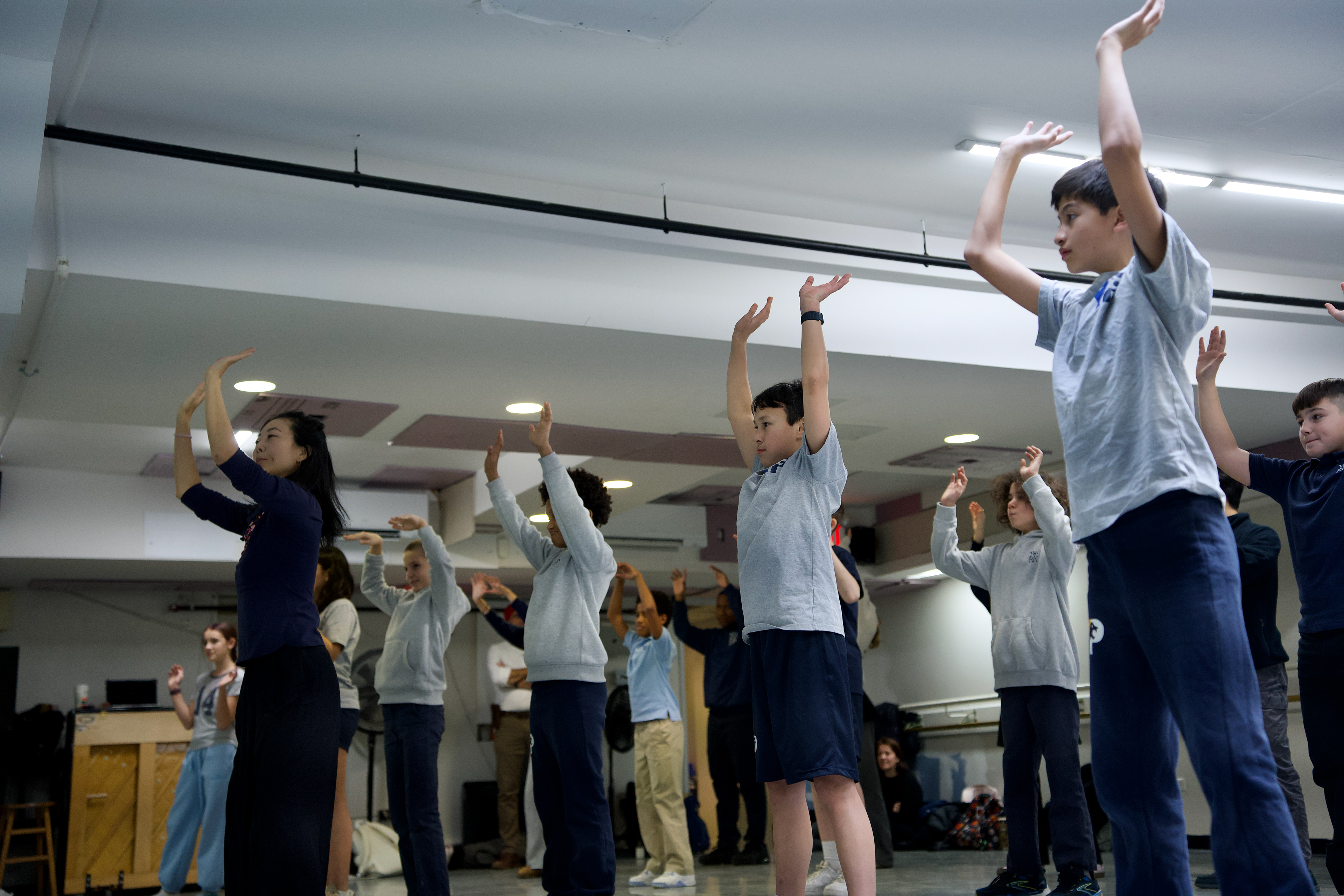
Students follow instructor Ling Tang through an arm-raising exercise during a Chinese dance class in Manhattan on Tuesday, Dec. 8, 2025. ©Chengchao Li 2025
Her classrooms are modern in other ways, too. She does not assign roles based on gender. She trains older students to lead warm-ups. She draws diagrams for classroom teachers who have never danced. And she has learned that in American schools, authority works differently.
“In the U.S., being a teacher means listening,” she said. “You can’t just demand discipline. You have to explain why.”
That “why” is where the translation happens. It is the moment a fan becomes more than just a prop. It becomes a reason.
For years, cultural exchange was not just a metaphor in Ling’s life; it was her profession. She worked with Flushing Town Hall, an arts organization that moved artists between cities and stages, building collaboration across languages and borders.
She remembers the era around the 2008 Beijing Olympics, when China felt unusually connected to the world. Internet access was broader, international projects felt possible, and the idea of building a career across two countries sounded inspiring.
Then, she said, she watched the digital door slam.
In 2009, while visiting China, she realized that major global platforms were suddenly inaccessible. Google and Facebook would not open. She connected the shift to the period following the July 5 unrest in Urumqi.
After that, she said, “you couldn’t go back” to that earlier sense of openness. The change wasn’t just technological; it was a signal of what kind of connection would be allowed going forward.
Over the years, those constraints intensified. Information became harder to access. Dialogue felt harder to sustain. And after the pandemic, she said, the exchange work nearly disappeared.
“It’s a pity,” she said. “The internet isn’t open, information isn’t open—and ideology can’t dialogue with the world.”
The closing wasn’t only happening inside China. In the United States, suspicion around China also grew, complicating funding, partnerships, and travel. The harder the border became, the more “cross-cultural work” started to look like a political act – even when it was simply art.
Ling did not frame herself as an activist. She did not want her career reduced to policy. But she could feel the contraction: programs became cautious, residencies were harder to navigate, and partnerships felt fragile. The one place where her work remained unquestionably legitimate was the classroom – because it was local, immediate, and human-scale.
When movement between countries slowed, she focused on movement inside rooms.
On March 14, 2020, schools in New York closed. The classroom, Ling’s most physical space, collapsed into a laptop screen. Students practiced in narrow bedrooms and shared apartments. Camera angles flattened their movement; internet lag broke their timing. Like many teaching artists, she tried to adapt, but she felt how much dance depends on shared space.
Online teaching, she said, is “very limited.” You can demonstrate steps, but you lose the architecture of attention: who is drifting, who is copying without understanding, who needs the group to feel brave.
At the same time, Wuhan, the city attached to her own history, became a global shorthand for blame. While she worried about family members in China, she watched stigma grow in the U.S. through jokes and sideways comments. Her mother, who had traveled from Wuhan just before the lockdown [when exactly], was even told not to participate in a United Nations-related performance because of where she had come from.
What had once been geography became an accusation.
Ling described these as small cuts, not dramatic, but steady. For someone whose work depends on trust, those moments mattered. They were reminders that cultural transmission is never just aesthetic. It is also political, even when you don’t ask it to be.
Back in the auditorium, the class wound down toward dismissal. Students folded fans, passed ribbons down the row, and adjusted their sneakers. Ling knelt to tie a child’s shoe. A student tripped and laughed, and the room hummed with ordinary sounds: chairs scraping, children talking over each other, teachers signaling time.
This, too, was part of her work, the insistence that culture is not only spectacle. It is care. It is repetition. It is the quiet trust built in a room where a child can shout “sushi” and still be invited into the lesson.
When she talks to younger dancers and immigrant artists now, her advice begins not with technique, but with direction.
“Be yourself,” she tells them. If you are doing something you truly love, she says, it won’t feel like work.
She urges them to learn languages, to write, to read, and to understand institutions. The artist, she insists, must be able to explain what they are doing – especially when the world around them keeps asking whose side they are on.
Outside, the rain had not stopped. Ling zipped her jacket, pulled on a red hat, and slung a backpack over her shoulder. The stage props stayed behind: fans, ribbons, and bright cloth folded into a box.
She stepped out into the wet afternoon, carrying something less visible with her, the belief that when borders harden, culture can still move, as long as someone is willing to translate it one room at a time.
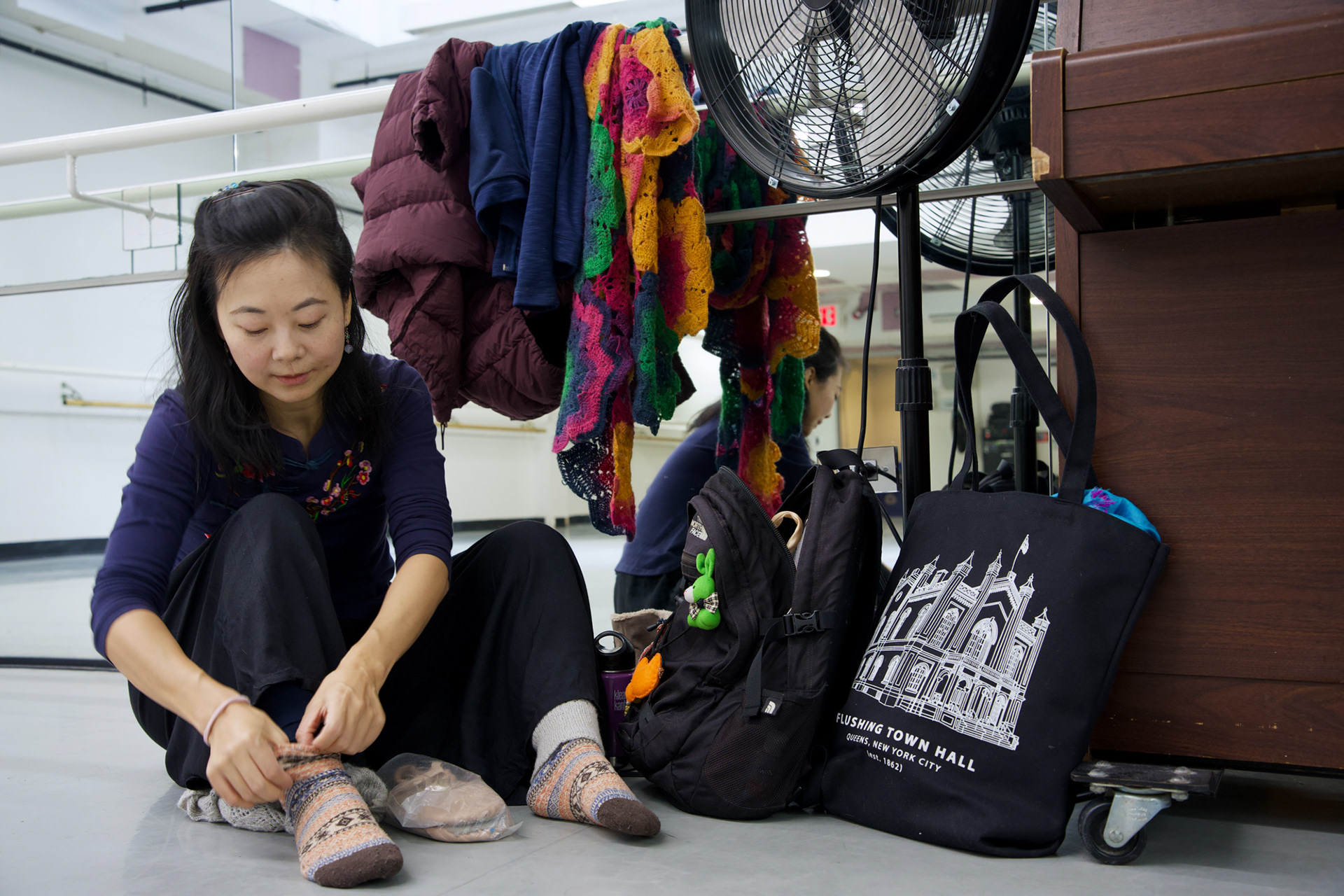
Ling Tang changes her dance shoes after class at York Prep School in New York on Monday, Dec. 8, 2025. Tang carried props, costumes and teaching materials for her Chinese performing arts workshop. ©Chengchao Li 2025