Despite Drop in Incidents, NYC Transit Workers Still on Front Line of City’s Mental Health Crisis
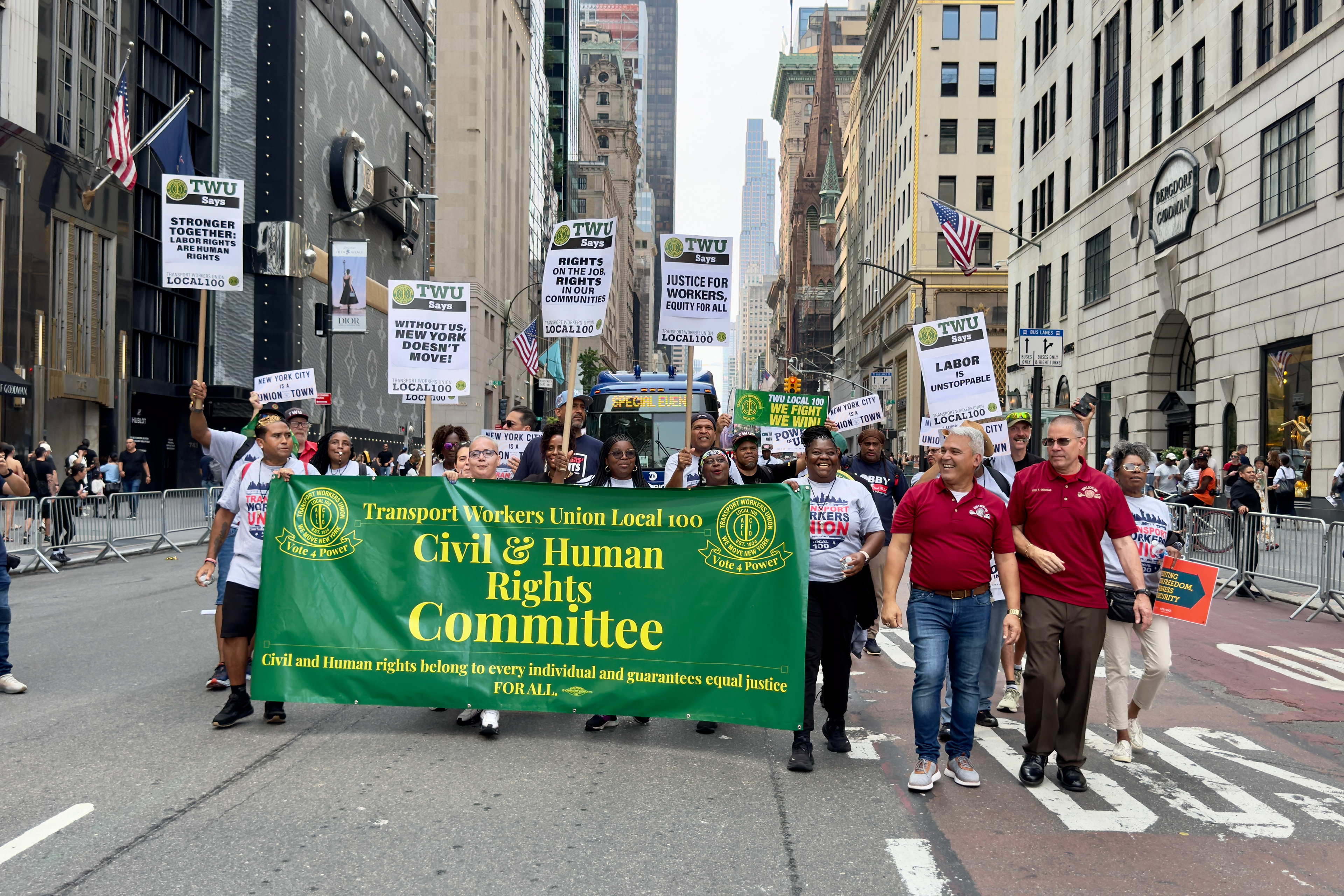
Members of the Transport Workers Union Local 100 marched in the Labor Day Parade on September 6, 2025. (Labor Files/Chengchao Li)
By Chengchao Li, September 17, 2025
The job for New York City’s transit workers has evolved from managing schedules to navigating a public health crisis. While official reports indicate a drop in major crimes, frontline workers say they continue to be assaulted by mentally ill passengers.
According to NYPD data, subway crime fell 5.4% in 2024, the second consecutive year of decline, as ridership rose to post-pandemic highs. However, Vital City analysts found subway assaults have tripled since 2009, with the per-ride violent crime rate stabilizing at levels higher than before the pandemic. An MTA report shows that while total assaults against workers declined 31% from 2023 to 2024, 116 assaults were recorded in 2024.
"[After the Covid-19], mental issues people have intensified," John Wachnicki, a bus driver, said he must “ask the corp to deal with them” when individuals become aggressive. Passengers also noted challenges, as Rider Mingyuan Kuang said "stained seats and seats occupied by sleeping homeless and mentally challenged people." Another rider, Nicky Sunshine, recounted an incident of sexual harassment by mentally ill person that forced her to use pepper spray.
These attacks are not the same. Assaults on bus drivers often stem from disputes, like one punched in Midtown or another sliced during a route detour. In contrast, subway worker attacks are "random" and "totally unprovoked," according to union leaders, as seen when a veteran was stabbed after a passenger refused to leave a train.
Even with crime down, TWU Local 100 leaders continue to advocate for action. "We cannot be superiors and just keep the trains moving," Noah L. Rodriguez, a former train operator and current communication director for TWU Local 100, said. "So if there’s a disservice, get the police involved." The union's president, John V. Chiarello, called the problem a public health issue the transit system cannot solve alone. An analysis found that among frequent offenders in 2023, 59% had documented mental health issues and 65% had a history of either homelessness or an emotional disturbance.
The city government acknowledges the issue. Deputy Press Secretary William D. Fowler said the Subway Safety Plan has helped "over 3,500 people who were formerly living on the subway get connected to a low barrier shelter bed." The Compassionate Interventions Act also expands the authority of clinicians to bring severely ill individuals to hospitals for substance use disorder.
These initiatives deploy specialized teams of mental health clinicians and police officers to connect with vulnerable individuals. Despite these efforts, the TWU local 100 still wants to work with the government to push on the subway safety issue. “We want people to be put in the hospital and then receive the treatment that they need and then come out and hopefully adapt to society, not that they got to live on the ground,” Chiarello said.
────────────────────────
NYC Bus Drivers Skeptical of Mamdani's Fare-Free Bus Proposal
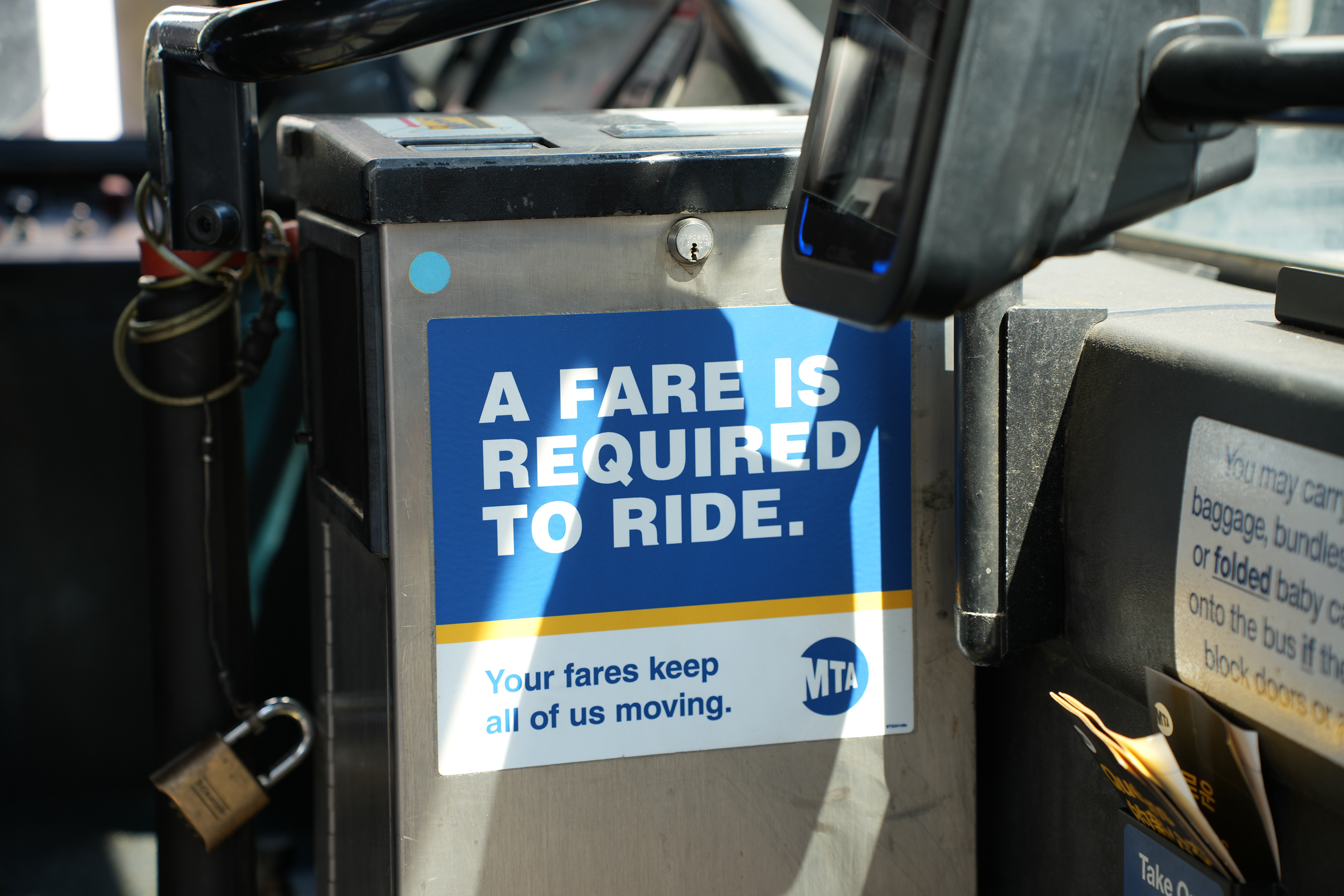
The MTA’s fare box on the bus, reminds passengers that “a fare is required to ride.” (Labor Files/Chengchao Li)
By Chengchao Li, September 24, 2025
Mayoral hopeful Zohran Mamdani champions a city-wide fare-free bus system as a solution to New York’s affordability crisis. While this proposal offers a clear benefit for riders, it has created anxiety for bus drivers who fear its potential negative consequences.
The debate over this plan is influenced by a 2023 MTA pilot program that tested fare-free routes. The evaluation found a 40% decrease in physical and verbal assaults on bus operators, as they were no longer responsible for fare enforcement. But the pilot also exposed key challenges. The 30% jump in ridership directly led to slower bus speeds and longer wait times at stops. A large portion of this growth was existing riders shifting to the free routes rather than new riders, and the program correlated with increased fare evasion on nearby paid lines.
For many drivers, a primary concern is financial viability. Bus operator Leonardo Gonzalez wondered how the city would fund the service. The MTA relies on fares to cover about a quarter of its nearly $20 billion annual operating budget. A city-wide program could create an annual revenue gap of over $700 million, according to the MTA's own analysis. Mamdani's campaign has suggested covering the cost by tapping into unpaid landlord fines and raising taxes on the wealthy. "New Yorkers are still going to have to pay," Gonzalez said. "whether through taxes or fares."
Beyond the financial worries, drivers are also concerned about safety, particularly overcrowding. Elisé Nerette, an MTA bus operator, said that a packed bus could obstruct a driver's view, especially through side mirrors. He shared a story of a fellow driver who was involved in a fatal accident due to a blind spot. While the MTA has a special unit, the "Eagle Team," dedicated to fare enforcement, some drivers still feel compelled to confront non-paying riders, putting themselves at risk.
However, the Transit Workers Union believes the safety benefits outweigh the potential drawbacks. The union's international president, John Samuelsen, told City&State New York that they would "wholeheartedly support any and all of these efforts" to eliminate fares, citing the direct link between fare collection and assaults on staff.
The rider perspective remains largely positive. Morgan Wong, a New York bus rider, said that fare-free buses would provide crucial relief from the city's rising cost of living. "Things just keep going up," Wong said. "So having some sort of relief... would just be so nice for everybody."
"I'm with either-or, because it gives a sense of hope to the people. But at the same time, you have to help yourself as well,” Nerette said. “I don't want to cut myself short, just so I can help somebody that probably don't even care about me."
────────────────────────
How Food Delivery and Buses Became Unwitting Rivals on New York’s Streets
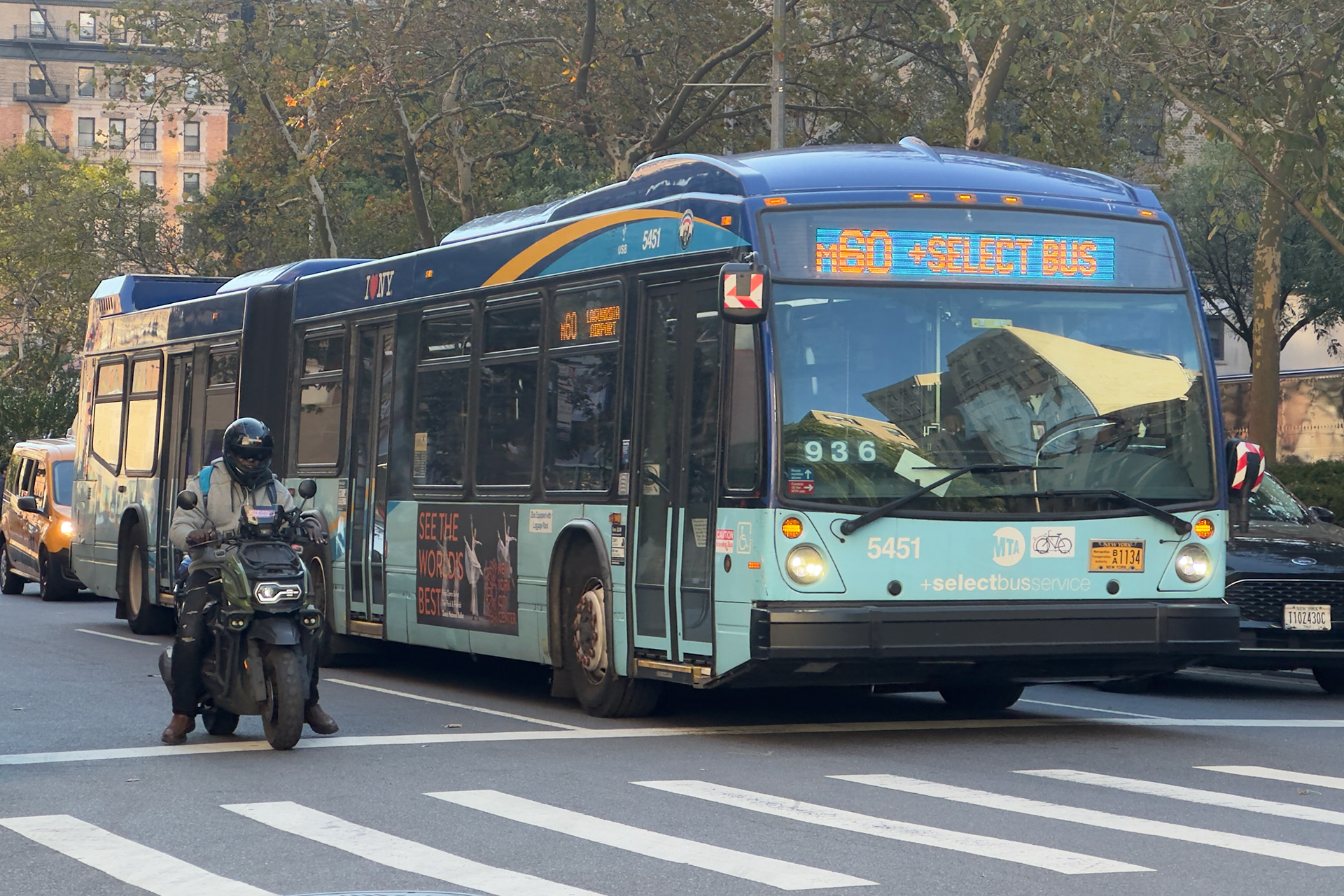
The bus and the food delivery driver are waiting for the traffic light together on the crossing. (Labor Files/Chengchao Li)
By Chengchao Li, October 1, 2025
New York City’s streets are the scene of an unexpected conflict. On one side, the bus drivers rush to stay on schedule, operating massive vehicles filled with people every day. On the other side, the food delivery drivers, racing against an app’s timer to drop off a hot meal. These two groups have become unexpected rivals, competing in a daily and often dangerous fight for space on crowded streets.
This constant street competition is a big problem for 1.1 million New Yorkers who ride the bus. According to the recent data, City buses speeds have dropped to a mere 8.1 miles per hour. City officials and commuters agree on a main reason: the huge growth in app-based delivery services is flooding the streets with an estimated 65,000 couriers.
This constant competition puts bus operators in a tough spot. “It’s quite a problem to the [bus] drivers because as far as for them, they want to get to their locations as soon as possible,” Elise Nerette, a bus driver in Queens, said. “So most times they quickly sneak into our blind spot and cut in front of us, so that makes it more difficult for a bus operating to remain forward with safety.”
Meanwhile, delivery workers feel stuck between traffic rules and the apps’ harsh demands. “The app is always timing you,” Fenyi Zhang, an Uber Eats driver, said. “I have to run red lights and sometimes even get into accidents with other drivers.”
App incentives and time pressure have a significant impact on how delivery workers make safety decisions. The payment system pushes workers to prioritize speed and efficiency over their own safety due to the fear of penalties and the threat of deactivation. According to the representative from Justice for App Workers, a national coalition movement that represents the delivery workers in the U.S..
But as tensions rise, many commuters and advocates believe these two groups are just fighting over scraps. They believe the real issue is the city’s decades-long prioritization of private cars. An analysis from the Transportation Alternatives found that nearly 75 percent of the city’s street space is devoted to moving or storing cars. Both buses and food deliveries rely on the same curb space. Buses need room to pull in and out people, while delivery workers need to wait near curbs to deal with orders, when the curb space is limited, the conflict happens.
In response, the Department of Transportation is speeding up the “NYC Streets Plan,” a city law passed in 2019. This law requires the city to build hundreds to miles of protected bus and bike lanes. The goal is to improve urban design to solve this chaotic problem.
Advocates from both groups support this new approach. The Transport Workers Union has long demanded for automated camera enforcement to keep bus lanes clear. At the same time, the Worker's Justice Project, representing the couriers known as “Los Deliveristas Unidos,” is pushing for safer infrastructure. As Nerette said, the solution is on "both sides." The city needs to create additional safer spaces, and the delivery companies must change their demands. While their vehicles are very different, their goals lead to the same demand: the city needs to take its streets back from the dominance of the car.
────────────────────────
TSA workers face growing uncertainty as government shutdown enters its third week
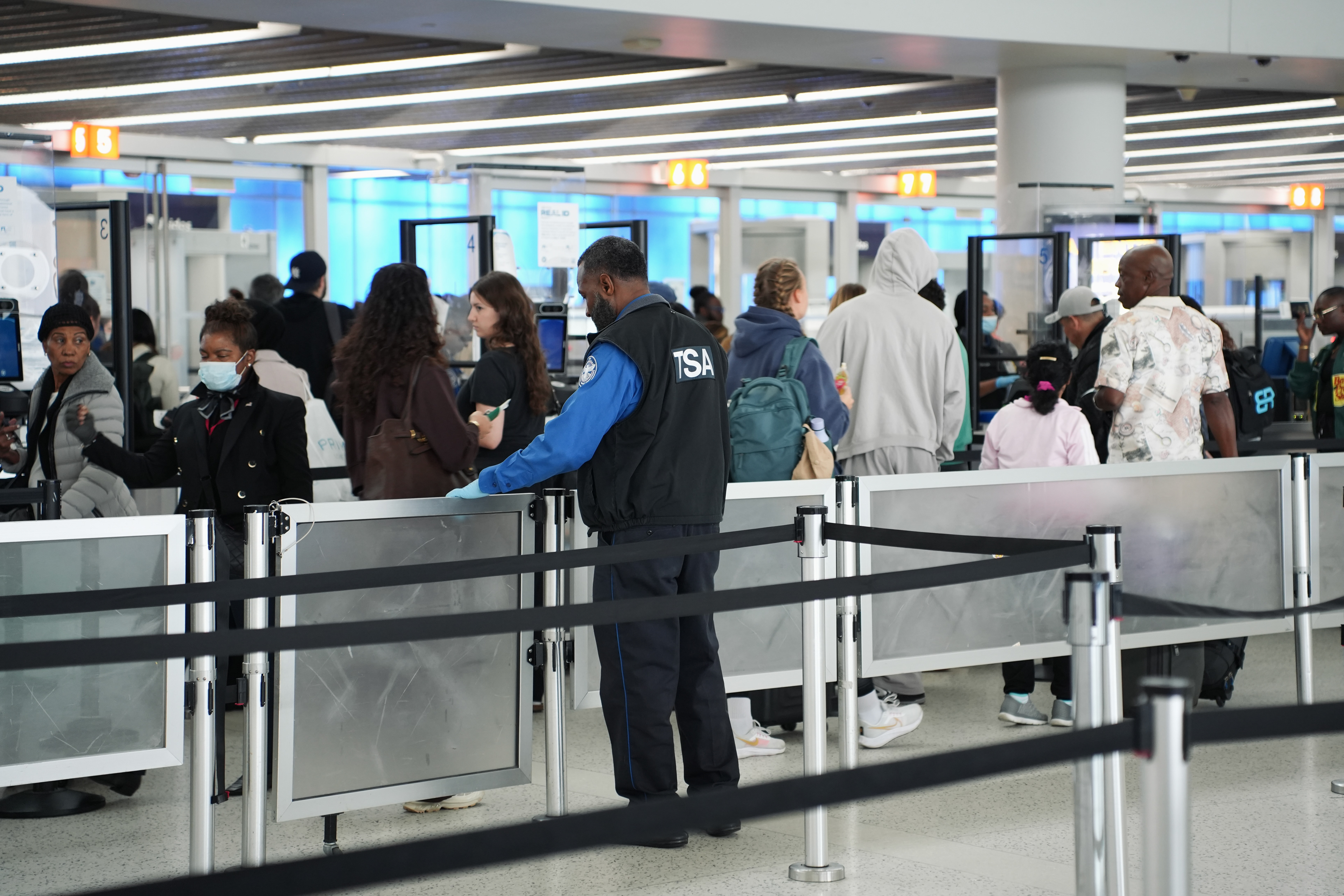
A TSA worker is manning the security checkpoint at John F. Kennedy International Airport in New York, N.Y. (Labor Files/Chengchao Li)
By Chengchao Li, October 16, 2025
As the federal government shutdown entered its third week, pressure has slowly spread throughout the nation’s airports, where more than 50,000 Transportation Security Administration officers are now working without pay.
For these TSA agents, this is a stressful situation: they must balance the professional duty of keeping people safe while facing the personal crisis of not having a paycheck. This is not the first time they have faced this situation in recent history. During the 35-day shutdown in 2018-2019, many TSA workers called in sick, some checkpoints closed and travelers faced long delays.
“Since the shutdown just started, everyone's emotions are still okay and people are showing up to work,” said Yuzhu, a TSA worker who asked that her real name not be used for fear of professional repercussions. But some cracks are beginning to show. “More people are taking time off, which leads to staffing shortages.”
“If Congress can't make a deal,” Yuzhu said, “I predict people won't be able to afford to come back to work.”
Hundreds of thousands of TSA workers received reduced paychecks last week. Now they are wondering if they will receive their next paycheck in two weeks. Although they are promised back pay after the shutdown ends, the missed paycheck is already harming morale and could lead some workers to stop showing up. In fact, the financial pressure is very harsh for TSA workers, who earn between $46,000 and $55,000 a year, according to TSACareer.com. That makes them especially vulnerable to even one missed paycheck.
“How would TSA workers pay the rent, mortgage, food, gas, childcare?” said Mac Johnson, an Executive Vice President at the AFGE TSA Council 100, the union representing 43,000 TSA officers around the nation.
In response, unions are stepping in to help, using plans they developed during the shutdown of 2018-2019. Johnson said union leaders are talking with TSA management and asking them to be empathetic to the stress employees have. Their plan includes connecting workers with resources like local food banks and even shelters if officers are at risk of eviction.
Victor Payes, the Fair Practice Coordinator at AFGE TSA Council 100, said union leaders are not only coordinating grassroots assistance but also pushing legal and political measures. During past shutdowns, AFGE and other unions sued against mass dismissals of unpaid essential workers. Now, Payes said, they are also pressuring Congress and local and state governments to pass protections so that workers won’t be left vulnerable in the meantime.
The shutdown’s impact creates a clear disparity within the airport. While federal workers have to continue working without pay, private-sector employees like flight attendants and baggage handlers are still getting their paychecks. The group that might be most affected is contract workers—like janitors, wheelchair attendants and food service staff—who are often furloughed by the government without any promise of getting paid back later, according to Alex Daugherty, the communication director of the Transport Worker Union of America.
For now, this growing crisis is mostly invisible to the public. Travelers going through the nation’s airports have said there are few problems. “The TSA goes smoothly right now, I don’t see any impact,” said Luna Liu, a student traveling through a New York airport recently.
But that calm is fragile, and not universal. Less than a week into the shutdown, the control tower at Hollywood Burbank Airport in California went dark overnight, forcing pilots to coordinate landings themselves and causing flight delays for hours. Major hubs like Boston, Philadelphia, Atlanta and Houston are also feeling strain as unpaid air traffic controllers call out more often, leading to delays nationwide in recent days.
Daugherty said that the longer people go without pay, the more their morale drops. “If it’s an air traffic controller, it can affect people’s experience at the airport,” he said. “If it’s TSA agents, lines could become extremely long.”
Besides the immediate travel problems, union officials worry about the long-term damage to the workforce. The shutdowns make it harder to keep employees in an agency that already has a problem with high turnover.
“Our bigger concern,” Payes said, “is it makes TSA become a difficult place to retain employees going forward because people will say, ‘This is the experience I have to go through, I’m going to leave for other employment.’”
Yuzhu, the TSA agent, said there was nothing the union could do for her. “The only thing I want is food,” she said.
────────────────────────